
Karex, the Malaysian company that makes roughly one in five of the world's condoms -- about five billion a year, supplying Durex and Trojan among others -- announced this week that it is raising prices by up to 30 percent. The reason is the Strait of Hormuz.

Amidst the stalling of high-level peace talks between Tehran and Washington, Iran continues to endure severe digital isolation as the nationwide internet blackout reached its 44th day on Sunday.

The White House has responded cautiously to reports of Pakistan offering to mediate between the US and Iran, amid ongoing tensions and potential talks.

...reopen for up to six months. Until then, the Strait stays nearly closed. The world pays. And no one, including the man who started this, can say when it ends, notes Prem Panicker in his must read blog on the Iran War.

The clock on the ceasefire is running out. But everyone's already whispering about round two, possibly as soon as this weekend.
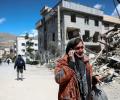
Fleur Hassan-Nahoum, special envoy, foreign ministry of Israel, has asserted that the situation has effectively been a "multi-front regional conflict" since its inception, while claiming significant military and strategic gains against adversarial forces.

For India, much is at stake: Crucial energy supplies traversing the Strait of Hormuz, the fate of its 10 million citizens living and working in West Asia -- who send generous remittances home -- and its major trade links with the region.

Trump said the summit ended with no agreement because he was not willing to lift all the sanctions on North Korea.

External Affairs Minister S Jaishankar and US Secretary of State Marco Rubio discussed cooperation in trade, critical minerals, nuclear energy, and defence, reaffirming commitment to a free and open Indo-Pacific.

Hours after ceasefire, US President Donald Trump on Wednesday warned against any country supplying military weapons to the Islamic Republic, stating that he would impose a 50 percent tariff on all goods exported to the United States.

Israel will continue its offensive in South Lebanon aimed at neutralising the threat from Hezbollah, which is backed by Iran.

US President Donald Trump's threats against Iran have drawn strong condemnation from Democrat leaders, who are calling for his removal from office, while some Republicans express concern.

The 'rescue' operation occurred within kilometres of Iran's underground tunnel complex at Isfahan, assessed by the IAEA and US intelligence as holding a substantial portion of the country's 60 per cent enriched uranium stockpile. Retired senior US military officers have highlighted that the mission's footprint -- hundreds of special operators, multiple heavy-lift aircraft deep inside Iran -- appears outsized for recovering a single airman. Prem Panicker continues his must read blog on the Iran War.

Saudi Arabia and the UAE are actively pushing Trump to take the war to its bitter finish and 'erase' Iran's presence in the geopolitics of the region. Simply put, the two most powerful Sunni Arab oligarchies are on the same page as Israel. Such interference increases the risk of a breakdown in dialogue between the US and Iran, points out Ambassador M K Bhadrakumar.

Pakistani Prime Minister Shehbaz Sharif has briefed Saudi Crown Prince Mohammad bin Salman on Pakistan's diplomatic efforts to de-escalate the situation in West Asia. This follows Pakistan's offer to host talks between the US and Iran to resolve the ongoing conflict.

Trump claimed on social media that recent US-Iran discussions were 'very good and productive' and aimed at a 'complete and total resolution' of the conflict.

By all available indications, the White House drafted a face-saving note and handed it, ready-made, to Islamabad. Pakistani Prime Minister Shehbaz Sharif was supposed to then post it in the guise of a plea urging Trump to extend the deadline by two weeks 'to allow diplomacy to run its course'. Trump would then graciously accept Pakistan's 'request' and declare a ceasefire. Sharif dutifully posted the message on X. Except that he, or whoever was handling the account, forgot to delete the tell-tale first line visible in the edit history: 'Draft - Pakistan's PM Message on X'. Prem Panicker's must read blog on the Iran War.
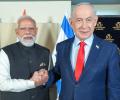
The Congress party has criticised the Indian government's diplomatic strategy, claiming a 'severe setback' if reports of Pakistan mediating between the US-Israel and Iran are accurate. The party alleges Pakistan's diplomatic engagement has surpassed India's, despite military successes.

The delegations from the US and Iran head to Islamabad on Friday, carrying a ceasefire that is already fraying, a Strait that is technically open and practically closed, and a negotiating agenda that would challenge even parties actually negotiating in good faith, which these groups are not. Prem Panicker continues his must read blog on the Iran War.

In his first major national address since hostilities began, Trump said the ongoing military campaign, dubbed 'Operation Epic Fury', has delivered 'swift, decisive, overwhelming victories'.

Israeli Prime Minister Benjamin Netanyahu announced a joint operation with the US against Iran, citing the threat posed by its nuclear ambitions and support for terrorism.

For weeks, the war skirted the edge of catastrophe without tipping over. Missiles flew, there was much destruction, commanders were assassinated, cities across the Gulf and even in Israel struggled to absorb the shock. But one line held: Energy infrastructure, the arteries of the global economy, remained largely untouched. That is no longer true. Prem Panicker continues his must read daily blog on the Gulf War.

The US President has previously made similar claims, stating that Sharif had credited him with saving millions of lives by helping end the conflict between the nuclear-armed neighbours.

Far from it; the country's resistance to the US, its nuclear ambitions, and its pursuit of influence and proxies across the Middle East are driven by a constant search for independence and security. Thus, Iran will never capitulate. Trump will learn this home truth ultimately, and it is going to be a humbling personal experience that may even destroy his presidency, predicts Ambassador M K Bhadrakumar.

The Americans can occupy Bab el Mandeb, claim to have 'solved' the Strait of Hormuz crisis, declare victory that President Trump so desperately needs, points out Colonel Anil A Athale, former head of the history division, ministry of defence.

Opposition leaders have criticised Prime Minister Narendra Modi's address to the nation, calling it politically motivated and a misuse of official platforms during ongoing elections.

'The next two to three weeks will not be decided in Washington.' 'They will be decided in Tehran, in whatever calculation Iran makes about the costs of continued resistance against the costs of appearing to have yielded.'

Pakistan's Prime Minister Shehbaz Sharif has engaged in extensive diplomatic efforts to de-escalate the conflict in West Asia, offering to host talks between the US and Iran and engaging with leaders from Saudi Arabia, Qatar, Malaysia, the UK, China, and the European Union.

'Much will depend on the position of the United States.' 'It will have to be seen to what extent the US will be more interested in achieving some form of a deal and to what extent Israel will be allowed to continue to carry out both airstrikes and the killing of Iranian officials.'
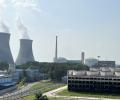
Russia has offered India cooperation in localising large and small nuclear power plants as part of a civil nuclear energy collaboration between the two countries. The offer was made during a meeting at the IAEA General Conference in Vienna.

Trump may strike. He may announce productive talks and extend again. He may do both at the same time. Iran will not open the Strait on someone else's terms, so no matter what happens, that problem will remain unsolved. And the IRGC will still be collecting its $2 million toll from every ship bold enough to ask permission to pass.

Alliances fight wars effectively only when they share an endgame. If Israel acted without US knowledge, then the military alliance is operating without real coordination at the level of strategic targeting. Neither picture is reassuring in a war that is no longer regional in its consequences. Prem Panicker continues his must read daily blog on the Gulf War.

The threat of wars hovers over the negotiations in Oman, but the good part is that Trump called the talks to be 'very good' and Iran's President Masoud Pezeshkian responded that they 'constitute a step forward', points out Ambassador M K Bhadrakumar.

Donald Trump claims his use of tariffs prevented a nuclear war between India and Pakistan, a claim India has repeatedly refuted.

As Iran heads into crucial peace talks with the United States of America, here are the six men who decide the Islamic Republic's course.
Extending its nuclear power plant supply relationship with India to the non-nuclear sector, Russia's integrated atomic power major Rosatom State Corporation is in talks for a 50:50 additive technology joint venture.

Gold prices surged in futures trading due to escalating US-Iran tensions, driving demand for the safe-haven asset.

As days turn into weeks and America loses more planes, as the destruction of trillions of dollars worth military assets piles up, and dead bodies of soldiers return in ever greater numbers in coffins, Trump will have to answer some very difficult questions to save his presidency, notes Ambassador M K Bhadrakumar.

As he settled down to his job as army chief, General Qamar Javed Bajwa -- who died last week; his passing did not merit even an obituary in major print or electronic media in Pakistan! -- developed a vision of reducing his country's and his institution, the army's traditional hostility toward India, points out Rana Banerji, who headed the Pakistan desk at RA&W.
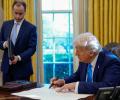
White House Press Secretary Karoline Leavitt noted that progress has been made in the Geneva talks with Iranian authorities, but the two nations stand 'far apart' on certain issues.
